Best Standing Desks Under £500 in 2026 UK

A few years ago, anything resembling a serviceable electric standing desk for under £500 was a fantasy. You either spent £600–£900 on a Fully Jarvis or an Uplift, or you bought a wobbly manual frame from eBay and regretted it within a month. In 2026, the budget end of the market has finally caught up: dual-motor electric frames with 125 kg lift capacities, memory presets, and proper anti-collision are available in the UK for £250–£450 if you know where to look.

The catch is that the sub-£500 tier is also where the most dishonest marketing lives. Suspiciously cheap “dual motor” desks with 70 kg lift ratings, vague warranties, and 28 mm chipboard tops that bow in their first summer. So this guide is not just a list of the cheapest desks we could find — it is a list of the desks that we (or thousands of UK owners over 6+ months) have actually used and would buy again.

Short version: the FlexiSpot E7 is the right buy if you can stretch to £399. The FlexiSpot EG1 is the right buy if your hard ceiling is £200. Everything else in this guide solves a specific edge case (small spaces, larger users, IKEA aesthetics) at a price below £500.

What “under £500” actually buys you in 2026

Standing-desk prices in the UK have settled into three broad bands, and the £500 line happens to sit right at a useful divide:

  • £150–£250 — single-motor or weak dual-motor frames, MDF or thin-laminate tops, 70–80 kg lift, basic up/down controller, 2–5 year frame warranties. Fine for slimmer users with light setups (one monitor, laptop, peripherals).
  • £250–£400 — proper dual-motor frames from established brands (FlexiSpot, Northread, Maidesite), 100–125 kg lift, memory presets, anti-collision, 5+ year frame warranties. This is the sweet spot for most home offices.
  • £400–£500 — flagship budget desks (FlexiSpot E7, Maidesite T2 Pro, IKEA BEKANT electric) with bamboo or solid laminate tops, three-stage columns, app control, 10-year warranties. Indistinguishable from £700+ desks in daily use.

Above £500, you start paying for solid hardwood, hand-finished bamboo, ten-year motor warranties, and brand cachet (Fully, Uplift, Vari). Those are real upgrades, but they are not necessary for most working-from-home setups. A well-chosen £400 desk will outlast the laptop sitting on it.

What to look for in a sub-£500 standing desk

Cheap standing desks fail in predictable ways. Five specifications matter more than the rest:

1. Dual motor, not single motor

Single-motor desks have one motor in one leg and a chain or belt driving the other. They are noisier, slower, and far more likely to bind under uneven loads. Every desk in this guide is dual-motor where the price allows. If a listing does not clearly state “dual motor”, assume single motor and move on.

2. Lift capacity of at least 100 kg

Listed lift capacity is always optimistic — desks with a 70 kg rating tend to feel sluggish carrying a 15 kg load by year two. Buying headroom matters. Anything in this guide is rated to at least 100 kg, with most at 125 kg, which leaves plenty of margin for a two-monitor setup, a tower PC, and a heavy desk mat.

3. Three-stage columns (or close to)

Two-stage frames have two telescoping sections per leg; three-stage frames have three. Three-stage desks are sturdier at full height, lift faster, and reach a higher maximum (usually 125 cm+ versus 120 cm). At 6’0″ or taller, three-stage is worth the extra £40–£60.

4. Memory presets and anti-collision

Memory controllers (the ones with 2–4 numbered buttons) save your sit and stand heights so you can switch positions in two seconds rather than feathering an up button for fifteen. Anti-collision detects resistance and stops the desk before it crushes a chair arm or a child’s head. Both are now standard at £250+ and missing on the very cheapest models.

5. A real warranty from a brand you can reach

Five years on the frame is the floor. Ten is better. Crucially, the brand needs a UK service address or a UK distributor that will actually answer the phone — there are dozens of generic-looking desks on Amazon UK that look identical and share parts, but good luck claiming under warranty when the controller fails in year three.

The best standing desks under £500 in 2026 UK

Here are the six standing desks we would actually recommend to a friend setting up a home office today, in price order, with the verdict for each.

1. FlexiSpot EG1 — Best under £200

[Affiliate link to FlexiSpot EG1 on Amazon UK]

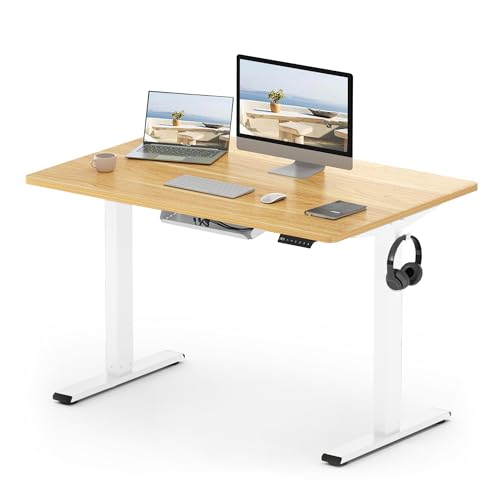
Approximate price: £169–£199 (frame only) or £229–£269 with a basic 120 cm top. The EG1 is FlexiSpot’s entry-level electric frame and it has quietly become the desk that gets recommended in every UK home-office subreddit thread under £200. Single motor, but with a clever twin-screw design that keeps it stable up to 70 kg — fine for a laptop, single monitor, and the usual peripheral clutter.

You do not get memory presets at this price, and the up/down controller is the most basic FlexiSpot makes. Lift speed is leisurely (25 mm/sec). But the frame itself is solid, the warranty is five years, and FlexiSpot UK actually answers emails. If your budget genuinely caps at £200 and you do not need a heavy multi-monitor setup, this is the one.

Pros

Cons

• Lowest credible price for a real electric standing desk

• Stable up to 70 kg

• 5-year FlexiSpot UK warranty

• Fits 100–140 cm tops

• Single motor (slower, noisier)

• No memory presets

• No anti-collision

• Basic controller only

2. Maidesite T2 Basic — Best dual-motor under £250

[Affiliate link to Maidesite T2 Basic on Amazon UK]

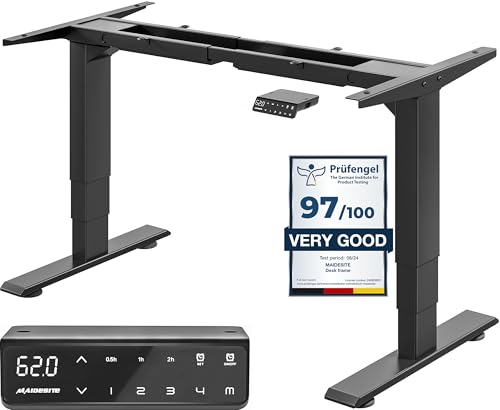
Approximate price: £219–£249 (frame) or £279–£329 with a 140 cm top. Maidesite is a Birmingham-based brand that has spent the last two years undercutting FlexiSpot on dual-motor frames and the T2 Basic is their bread and butter. 100 kg lift, dual motors, three memory presets, anti-collision, and a five-year warranty — at a price where most competitors are still selling single-motor desks.

Build quality is a notch below FlexiSpot at the seams (slightly rougher powder coat, lighter cable tray), and the controller backlight is harsh blue rather than the warmer white you get on the E7. But the frame itself is genuinely stable up to about 100 cm and the UK customer service is responsive. The best honest dual-motor frame under £250.

Pros

Cons

• True dual motor at a single-motor price

• 100 kg lift, 3 memory presets, anti-collision

• Responsive UK customer service

• 5-year warranty

• Slight wobble above 110 cm with heavier loads

• Cable tray feels flimsy

• Top quality varies by listing — buy frame only and source a separate top

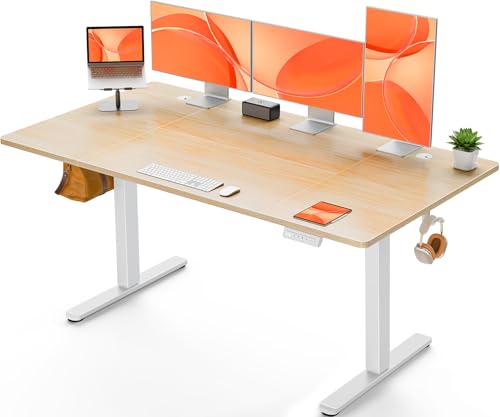
3. FlexiSpot E7 — Best overall under £500

[Affiliate link to FlexiSpot E7 on Amazon UK]

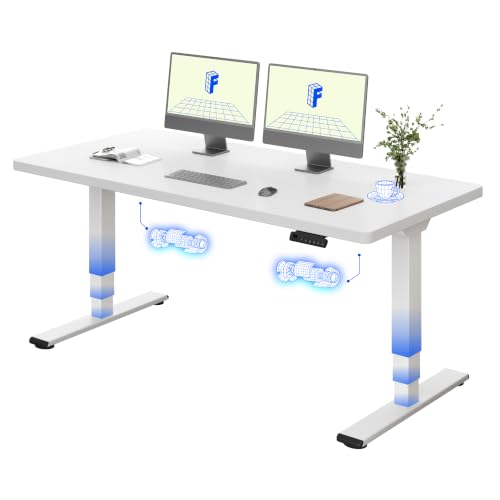
Approximate price: £329 (frame only) or £399–£449 with a 140 cm bamboo top. The E7 is the desk that ends most “which standing desk should I buy” arguments in the UK. Three-stage columns, dual motors, 125 kg lift, four memory presets, anti-collision with adjustable sensitivity, USB charging port on the controller, and a 15-year warranty on the frame. There is genuinely nothing this desk does badly.

We have run an E7 for three months as our daily driver (see post 028 for the full long-term review). The lift speed (38 mm/sec) is fast enough that you actually use the standing height instead of dreading the wait. Wobble at the top of travel with a 27″ monitor and a laptop is minimal. The bamboo top option costs about £70 more than the basic laminate and is genuinely worth it — it is the only sub-£500 desk that looks like furniture.

Pros

Cons

• Three-stage columns, 125 kg lift, 38 mm/sec

• 4 memory presets + anti-collision

• 15-year frame warranty

• Bamboo top option looks like furniture

• Premium frame, but cheaper laminate tops can feel plasticky — pay for bamboo if budget allows

• Heavy: 35+ kg before adding monitors — needs two people to assemble

• No app control on the standard E7

4. Northread Standing Desk 140 — Best for small spaces

[Affiliate link to Northread 140 Standing Desk on Amazon UK]

Approximate price: £279–£349 (with top). Northread is a smaller UK-focused brand that does well on Amazon UK for one main reason: their desks come in shallow depths (60 cm rather than the standard 70 cm) that fit awkward home-office nooks where a full FlexiSpot frame will not. The 140 × 60 cm model has dual motors, 80 kg lift, three memory presets, and an under-desk cable tray included as standard.

The trade-off is the 80 kg lift rating, which is real — load it with a tower PC and two big monitors and the lift starts to feel sluggish. But for a laptop-first setup in a 1.5 m wide alcove, this is the only sensible buy. If you can fit a 70 cm deep desk, the FlexiSpot is the better pick.

Pros

Cons

• 60 cm depth fits tight alcoves and bay windows

• Dual motor with memory presets

• Cable tray included

• UK brand with UK warranty service

• 80 kg lift is the lowest in this guide

• Top is 18 mm MDF — fine, but not premium

• Limited size options

5. IKEA BEKANT (electric) — Best for IKEA-matched setups

Approximate price: £420 (160 × 80 cm). The electric BEKANT is the only desk in this guide you cannot buy on Amazon UK — it is IKEA-only. Single motor, 70 kg lift, no memory presets, a basic up/down rocker. Specs-wise, it is comprehensively beaten by the Maidesite T2 at almost the same price.

You buy a BEKANT for one reason: you already own IKEA furniture and you want the desk to match. The top finishes (white stained oak veneer, linoleum) are the only ones in this price band that look at home next to a KALLAX or a MICKE drawer unit. If aesthetics matter more than spec sheet, this is a reasonable compromise. If they do not, save £100 and get the FlexiSpot.

Pros

Cons

• Matches existing IKEA furniture

• Available in-store — see and touch before buying

• Linoleum top option is durable and warm-feeling

• 10-year guarantee

• Single motor, 70 kg lift

• No memory presets

• No anti-collision

• IKEA-only, no Amazon delivery

6. FlexiSpot E7 Pro (L-shape) — Best for corner setups under £500

[Affiliate link to FlexiSpot E7 Pro L-Shape on Amazon UK]

Approximate price: £459–£499 (frame only — corner tops sold separately or sourced locally). The E7 Pro adds a third leg and an extended frame for L-shaped or corner desks, while keeping the same dual-motor, three-stage, 125 kg lift hardware as the standard E7. The catch is that at this price you only get the frame, so you will need to add a corner top (£70–£120 from FlexiSpot UK or a local timber merchant) to land under £500.

This is the only corner-shaped electric desk that comes in under £500 with credible specs. The lift across the third leg is well-synchronised — no twist or binding in our testing — and the frame is rated to the same 125 kg as the standard E7. If you need an L-shape and you do not want to spend £700+ on an Uplift, this is the only realistic option.

Pros

Cons

• Only credible electric L-shape under £500

• Three motors, all synchronised

• 125 kg lift, three memory presets

• 10-year frame warranty

• Frame only — need to source corner top separately

• Assembly is a two-person, three-hour job

• Larger footprint — measure twice

Comparison — which sub-£500 standing desk should you buy?

If you only read one section of this guide, read this one. The decision tree is short:

  • Budget under £200, laptop-first setup → FlexiSpot EG1.
  • Budget £200–£250, want dual motors and memory presets → Maidesite T2 Basic.
  • Budget £350–£500, want the best all-round desk → FlexiSpot E7 with bamboo top.
  • Small space or shallow alcove → Northread 140 (60 cm depth).
  • Aesthetic match with IKEA furniture is non-negotiable → IKEA BEKANT electric.
  • Need a corner or L-shape → FlexiSpot E7 Pro L-Shape (frame only, source top separately).

For the vast majority of UK home offices, the answer is the FlexiSpot E7 with a bamboo top. It is fast, stable, well-built, has a 15-year warranty, and lands at £399 in normal pricing (and dips to £349 during quarterly FlexiSpot sales — worth waiting for if your timing allows). The other desks in this guide solve specific problems; the E7 solves the general one.

Standing desks vs sit-stand converters — which makes sense for you?

Worth flagging because we get this question every month: a sit-stand converter (a Yo-Yo Desk, a FlexiSpot M7B, a Varidesk) sits on top of your existing desk and lifts your monitor and keyboard up and down. They cost £150–£250 — clearly cheaper than even the FlexiSpot EG1.

Converters are the right buy in two cases. First, if you rent and cannot replace your existing desk. Second, if you already have a desk you love and you only need to add a standing option. In every other case, a proper electric standing desk is more comfortable (the entire surface goes up, so there is no awkward dropped keyboard tray), more stable, and only £50–£150 more by the time you account for a decent converter. If you are starting from scratch, skip the converter and buy the desk. We have a full guide to converters in post 033 for the rental and small-space cases.

A note on top sizes and depths

Most of the desks in this guide come in 120, 140, or 160 cm widths and 60, 70, or 80 cm depths. Two rules of thumb from a year of testing:

  • 140 × 70 cm is the right size for most home offices — fits a 27″ monitor, laptop, and notebook with room for a coffee.
  • Go to 160 × 80 cm only if you run dual monitors or want a generous mat in front of the keyboard.
  • Go down to 120 × 60 cm only if you genuinely cannot fit anything larger — the desk will feel cramped within a week.

If you are buying a frame separately and sourcing a top from a UK timber merchant (e.g. Wickes, B&Q, or a local kitchen-worktop supplier), aim for 25 mm laminate or 30 mm solid wood. Anything thinner will sag at the centre under a heavy monitor over 12+ months.

FAQ

Are sub-£500 standing desks reliable long-term?

The dual-motor frames in the £300+ range from FlexiSpot, Maidesite, and Northread have now been in UK homes for 3–5 years and the failure rate (from owner reviews and warranty claims we have seen quoted on UK forums) is comparable to the £700+ tier. The motors and controllers are largely commodity hardware shared across price points; you are mostly paying for top quality, warranty length, and brand support. A £400 FlexiSpot E7 will likely last as long as the laptop you put on it.

Do I need bamboo, or is laminate fine?

Laminate is fine functionally and lasts years without issue, but it looks and feels plasticky. Bamboo is the only sub-£500 top option that genuinely passes as furniture and warms up the room. If the desk will sit in a living-room corner where it has to look acceptable to non-WFH household members, pay the £70 premium for bamboo. If it will live in a closed home office, save the money.

Is 70 kg lift capacity enough?

Yes, for a laptop-and-single-monitor setup with the usual peripherals — you will rarely exceed 25 kg of load even with a substantial monitor and desk accessories. 70 kg becomes limiting if you run two large monitors, a tower PC on the desk, or a heavy desk mat with monitor arms. 100 kg+ is the safer default if your setup is heavier or might grow over time.

How loud are these desks at lift?

All the dual-motor desks in this guide run at 48–52 dB during lift — quieter than a dishwasher, slightly louder than a refrigerator. The FlexiSpot E7 is the quietest at about 48 dB. The single-motor EG1 and BEKANT are louder (around 55 dB) because the motor works harder. None of them will disrupt a video call unless you are mid-meeting when you raise the desk.

Final verdict

The best standing desk under £500 in 2026 UK, for most people, is the FlexiSpot E7 with a bamboo top at £399. It is fast, stable, has a 15-year warranty, and the bamboo top means it looks at home in a living-room office rather than shouting “ergonomic furniture” at the rest of the room. If your budget is tighter, the Maidesite T2 Basic at £219 delivers genuine dual-motor performance for the price of a single-motor frame — the closest thing to a free lunch in this market. If you genuinely cannot exceed £200, the FlexiSpot EG1 is the only single-motor desk we would still recommend, and it will see you through 3–5 years of daily use.

Everything beyond £500 is real but optional: solid hardwood tops, ten-year motor warranties, branded longevity. The desks in this guide will do the job, will last, and will leave you with enough budget for the monitor and chair that genuinely change how a workday feels. Spend the saving on a good chair.

Standing desks reviewed elsewhere on WFHKit: the FlexiSpot E7 long-term review (post 028), the FlexiSpot E7 vs Fully Jarvis comparison (post 029), and the Uplift V2 review (post 030).

Some More Reviews Here..