If you have decided to buy a monitor light bar, and you should, the next decision is which BenQ to go for. On Amazon UK (September 2026) the original ScreenBar is £89 and the current ScreenBar Halo 2 is £149, so the gap is about £60. The Halo’s marketing makes the upgrade sound essential. After living with both for several months, the honest answer is: it depends on your room. Here is the side-by-side we wish we had read before deciding.
What both lamps share
Both are LED bars that clip onto the top edge of a monitor, use the same asymmetric optics so light lands on the desk rather than the screen, run on USB-A power, and offer stepless brightness and colour temperature from a warm 2700K to a cool 6500K. Build quality is the same: anodised aluminium body, sprung counterweight clip, no plastic creak. If you are choosing between either and a no-name £25 alternative, both BenQs are clearly worth the extra for light quality, colour rendering and long-term reliability.
The original BenQ ScreenBar
The original is £89 on Amazon UK, rated 4.7 stars from more than 4,500 ratings, and in stock. It does the core job, glare-free light on the desk, exactly as well as the Halo.

What the Halo adds
1. The ambient backlight
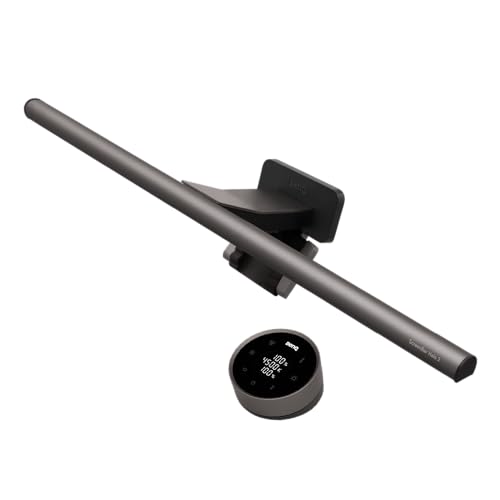
The flagship feature is a second strip of warmer LEDs facing backwards, bouncing light off the wall behind your monitor. In a dim room the contrast between a bright screen and a dark surround is tiring, and lifting the wall smooths it. It also lifts the wall behind you on video calls. If you often work in low light (early mornings, late evenings, blackout curtains) it is a meaningful upgrade; in a reliably bright room you will rarely notice it.
2. The wireless puck remote
The Halo comes with a small wireless dial that sits by your keyboard: one button cycles colour temperature and the dial controls brightness. If you change settings often it is a small daily luxury; if you leave the lamp on auto you will rarely use it.
3. Slightly smarter auto-dimming
On the Halo the ambient sensor sits on the puck at desk level rather than on the bar, which gives slightly more accurate readings when sunlight hits the back of the monitor but not the desk. It is marginal, but real.
The current model is the ScreenBar Halo 2, £149 on Amazon UK, rated 4.7 stars from 1,259 ratings and in stock.
Side-by-side comparison
Feature | ScreenBar (original) | ScreenBar Halo 2 |
Forward LEDs | Yes (asymmetric) | Yes (asymmetric) |
Backlight | No | Yes (warm) |
Wireless puck | No | Yes |
Colour temp range | 2700–6500K | 2700–6500K |
Power | USB-A 5V | USB-A 5V |
Auto-dimming sensor | On bar | On puck (better) |
UK price (Amazon, Sept 2026) | £89 | £149 |
Real-world differences after extended use
The Halo’s premium buys comfort and convenience, not better desk lighting: both bars light the desk identically. The backlight is genuinely useful late in the evening if you have not turned on the room lights, and the puck is great when tweaking brightness as daylight changes. If you set and forget, you will not miss the puck.
Who should buy the original ScreenBar?
- You work in a reliably well-lit room.
- You have a flat or gently curved monitor.
- You do not change lighting settings during the day.
- £60 matters and would be better spent elsewhere, such as a webcam or a desk lamp for a second area.
Who should buy the ScreenBar Halo 2?
- You often work in dim conditions.
- Eye strain by 5pm has been a real issue.
- You take a lot of video calls and want a softer wall behind you.
- You would actually use the puck.
- You have a deeper-curve monitor, which the Halo’s clip handles better.
What about the cheaper alternatives?
Budget bars from Quntis, Govee and others cost roughly a third as much and light the desk well, though the BenQs win on build, button feel and long-term reliability. If £149 is a stretch, the order of preference is BenQ ScreenBar (original), then a well-reviewed budget bar.
Frequently asked questions
Will either bar fit my curved ultrawide?
The Halo handles deeper curves more comfortably. The original is fine on flat panels and gentle curves but can wobble on a deep curve.
Can I use either with a USB-C-only monitor?
You will need a USB-A to USB-C adapter, about £5.
Does the Halo backlight need a wall behind it?
Yes. A plain light wall gives the best result; open space behind the desk wastes the effect.
Is the puck necessary if I rarely change settings?
No. The touch buttons on the original ScreenBar are perfectly fine.
The verdict
The original BenQ ScreenBar at £89 is the right buy for most home offices. Pay the extra £60 for the Halo 2 only if you genuinely work in dim conditions, take many video calls or have a deep-curve monitor. For everyone else, save the money.