Best Smart Desk Lamps with Circadian Lighting

If you work from home, the light on your desk does far more than help you read. The right colour temperature at the right time of day keeps you alert in the morning and helps you wind down by evening — and a growing number of lamps now adjust automatically to match. This guide rounds up the best smart desk lamp circadian options UK buyers can get in 2026, from a £45 app-controlled budget pick to Dyson’s £500 daylight-tracking flagship, with a clear recommendation for every budget.

We have lived with each of these on the corner of our desk through dark winter mornings and bright June afternoons, paying attention to how natural the colour shifts feel, whether the app is actually worth opening, and — most importantly — whether the lamp made a long working day more comfortable. Here is how they ranked, followed by a buying guide so you can choose the right one for your setup.

What circadian lighting actually means

Your body runs on a roughly 24-hour internal clock, the circadian rhythm, and light is the single strongest signal that sets it. Cool, blue-rich light in the 5,000–6,500K range mimics midday sun and tells your brain to stay alert. Warm light below about 3,000K mimics late-afternoon and evening, nudging the body towards rest. A circadian desk lamp simply automates that shift: cooler and brighter during your working hours, warmer and dimmer as the evening draws in.

For home workers this matters more than for most people. You may be sitting at the same desk from 8am to 6pm under lighting that never changes, which can leave you feeling wired late into the evening or sluggish in the morning. A lamp that tracks the time of day — or better still, tracks actual daylight outside — helps keep your body clock aligned even when you barely leave the house.

How we tested and what to look for

We judged every lamp on the things that matter for daily desk use, not just spec sheets. A few criteria did most of the sorting:

Colour temperature range

The wider the better. A genuinely useful circadian lamp should reach at least 2,700K at the warm end and 5,700K or higher at the cool end. Lamps with a narrow range cannot create a convincing morning-to-evening shift.

Brightness and glare control

Look for a quoted output of at least 400 lux at desk height, and an asymmetric or diffused design that throws light onto the desk rather than into your eyes. A bright lamp you have to squint past is worse than a dimmer one you can sit beside comfortably.

Automation and app control

This is what makes a lamp “smart”. The best options offer scheduling (warm-up and cool-down at set times), app or voice control, and ideally a daylight or auto mode that adjusts without any input from you. Cheaper lamps may only offer manual presets, which still help but need you to remember to use them.

Build, footprint and controls

A desk lamp lives in your peripheral vision all day. We preferred matte finishes, stable bases or clamps that free up desk space, and physical touch controls so you are not forced into the app for a quick dimming.

The best smart desk lamps with circadian lighting in 2026

1. Dyson Lightcycle Morph — best overall (premium)

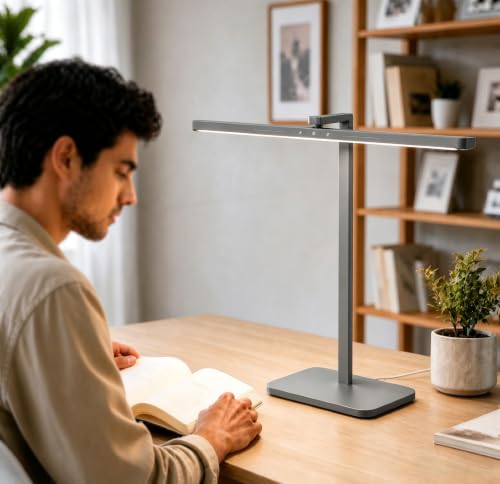
The Lightcycle Morph remains the most complete circadian desk lamp you can buy, and the one that takes the science most seriously. It continuously calculates the local daylight colour and brightness for your exact location and time, then matches it — so at 9am it is cool and bright, and by 8pm it has warmed considerably without you touching anything. The single LED head pivots, rotates and slides so it works as a task light, a downlight or, pointed at the ceiling, indirect ambient lighting. Build quality is exceptional and Dyson rates the LEDs for around 60 years of use.

It is expensive at roughly £400–£500, and the app, while capable, is more than most people need. But if you want the best and you spend long days at your desk, nothing else matches its automation. [Affiliate link to Dyson Lightcycle Morph on Amazon UK]

Pros:

  • Genuine daylight-tracking that needs zero manual input
  • Huge 2,700–6,500K range and very high, even brightness
  • Flexible head doubles as task and ambient light

Cons:

  • Premium price that is hard to justify for casual use
  • App is fiddly and arguably over-engineered

2. Xiaomi Mi Smart LED Desk Lamp Pro — best value

For around £55–£65 the Mi Desk Lamp Pro is the sweet spot for most home workers. It offers a full 2,700–6,500K tunable range, a bright and even light field, touch controls on the base, and proper app scheduling through the Mi Home app — so you can set it to start cool in the morning and warm down in the afternoon automatically. It also works with Google Assistant and Alexa. It is not a true daylight tracker like the Dyson, but its scheduling delivers most of the circadian benefit for roughly a tenth of the price.

The plasticky base will not win design awards, and you need a Xiaomi account to unlock the smart features, but the value on offer is hard to argue with. [Affiliate link to Xiaomi Mi Smart LED Desk Lamp Pro on Amazon UK]

Pros:

  • Full tunable-white range with reliable app scheduling
  • Alexa and Google Assistant support
  • Excellent price for the feature set

Cons:

  • Requires a Xiaomi account and the Mi Home app
  • Time-based scheduling only, not true daylight tracking

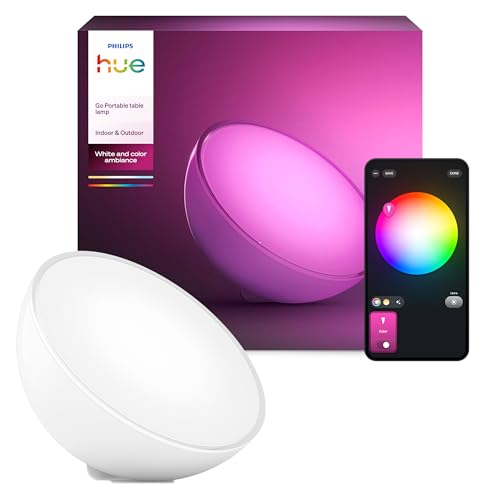
3. Philips Hue desk setup (Hue Go + bridge) — best for a connected home

If you already run Philips Hue elsewhere in the house, building your desk lighting into the same system is the most flexible route. With a Hue bridge, Adaptive Lighting automatically shifts your bulbs’ colour temperature across the day in line with circadian principles. A portable Hue Go (around £80) or a Hue table lamp sits neatly on a desk, and you get the deepest automation and routine options of anything here through the Hue app, plus rock-solid Alexa, Google and Apple Home support.

The catch is cost and complexity: you really want the bridge (around £50) for the best features, so the true entry price climbs. But for an existing Hue household it is the obvious pick. [Affiliate link to Philips Hue Go portable lamp on Amazon UK]

Pros:

  • Adaptive Lighting handles circadian shifts automatically
  • Best-in-class app, routines and smart-home integration
  • Expandable to your whole room and home

Cons:

  • Needs a bridge for full functionality, raising the real cost
  • Not a dedicated task lamp — light is softer and less focused

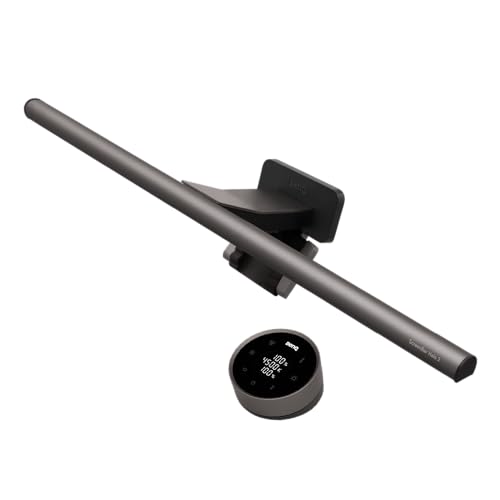
4. BenQ ScreenBar Halo 2 — best if you stare at a monitor all day

Technically a monitor light bar rather than a desk lamp, but it earns a place here because it solves the same problem more elegantly for screen-heavy work. It clips to the top of your monitor, lights the desk and keyboard without casting any glare on the screen, and offers a wide tunable-white range with an auto-dimming mode that responds to ambient light. It frees the desk surface entirely. If your day is mostly spent in front of a monitor, this is the most ergonomic way to get tunable lighting — we review it in full in our dedicated ScreenBar Halo 2 post.

It is not a true scheduled-circadian device, and at around £150 it is pricier than many lamps, but the zero-glare, zero-footprint design is genuinely excellent. [Affiliate link to BenQ ScreenBar Halo 2 on Amazon UK]

Pros:

  • No desk footprint and zero screen glare
  • Wide tunable-white range with auto-brightness
  • Wireless controller is a joy to use

Cons:

  • No time-based circadian scheduling
  • Only useful if you work at a monitor

5. Govee Smart Desk Lamp Pro — best budget pick

At around £45 the Govee Smart Desk Lamp Pro is the cheapest lamp here we would happily recommend. It covers a 2,200–6,500K range, supports Wi-Fi, app scheduling and Alexa/Google control, and includes a useful presence sensor that dims when you step away. The light quality is a small step behind the Xiaomi and the app leans towards RGB effects you will never use, but for a first smart desk lamp on a tight budget it delivers the core circadian features and nothing essential is missing.

[Affiliate link to Govee Smart Desk Lamp Pro on Amazon UK]

Pros:

  • Cheapest genuinely smart, schedulable option
  • Presence sensor and Alexa/Google support

Cons:

  • Light quality a notch below pricier rivals
  • App is cluttered with effects aimed at gamers

Smart desk lamp comparison

LampApprox. priceColour rangeAuto/circadian modeBest for
Dyson Lightcycle Morph£400–£5002,700–6,500KLive daylight trackingBest overall, premium
Xiaomi Mi Desk Lamp Pro£55–£652,700–6,500KApp schedulingBest value
Philips Hue Go + bridge£80 + £502,200–6,500KAdaptive LightingConnected homes
BenQ ScreenBar Halo 2~£1502,700–6,500KAuto-brightnessMonitor-based work
Govee Smart Desk Lamp Pro~£452,200–6,500KApp schedulingTight budgets

Smart desk lamp buying guide

If you are choosing your first circadian lamp, three questions settle most decisions. First, do you want true automation or are scheduled presets enough? Only the Dyson tracks live daylight; the others rely on time-based schedules you set once and forget. For most people, a good schedule is genuinely enough — the difference is one of polish rather than effect.

Second, how much desk space do you have? If your desk is small or dominated by a monitor, a clamp lamp or the BenQ light bar will serve you far better than a lamp with a wide base. Third, do you already own a smart-home ecosystem? If you run Hue, Alexa or Google routines, picking a lamp that slots into what you have avoids juggling yet another app.

One practical tip: whatever you buy, set the cool-to-warm transition to begin a couple of hours before you stop work, not at the moment you log off. Easing the colour temperature down gradually through the late afternoon is far more effective for protecting your evening sleep than a sudden switch at 6pm.

Which smart desk lamp should you buy?

For most home workers, the Xiaomi Mi Smart LED Desk Lamp Pro is the one to get: it delivers the full circadian colour range and reliable scheduling for around £60, and you will not feel you have compromised. If money is no object and you want the lamp to manage itself entirely, the Dyson Lightcycle Morph is the best smart desk lamp circadian device on the market and worth every penny for heavy desk users. Run a Hue household already? Add a Hue Go and let Adaptive Lighting do the work. Work mostly at a monitor? The BenQ ScreenBar Halo 2 is the most ergonomic answer. And on the tightest budget, the Govee Smart Desk Lamp Pro covers the essentials for around £45.

Whichever you choose, the upgrade from flat, unchanging desk lighting to a lamp that shifts with your day is one of the most underrated improvements you can make to a home office — your eyes, and your evenings, will thank you.

Some More Reviews Here..