An under-desk cable tray is the single most effective tidy-up tool in any home office. For under £30 it lifts your power strip, chargers and cable slack off the floor and out of sight. The tricky part is choosing the right one: build quality, fitting method and capacity differ more than the marketing photos suggest. This is a focused guide to the best under-desk cable trays available on Amazon UK in 2026 (prices checked September 2026), organised by what kind of desk you have and whether you can drill into it.
Why an under-desk tray beats every other cable solution
Most cable products handle one cable run. A tray solves the whole problem at the source: the power strip and every charger live in the tray, and only the cables that must leave the desk stay visible. Compared with a floor box, a tray is invisible; compared with sleeves alone, it contains the heavy stuff instead of just dressing the cables that hang off it.
Types of under-desk cable tray
- Screw-in mesh or metal trays: the strongest and most reliable option, but you have to drill into the desk.
- No-drill clamp-on trays: brackets with clamps that grip the desk edge, so nothing to drill or stick, but limited to certain desk thicknesses.
- Adhesive trays: 3M-style pads instead of brackets, fine for light loads on clean wood, less reliable on glass or worn melamine.
- Cable boxes (floor-standing): a plastic box on the floor that hides a power strip, useful where a tray will not fit.
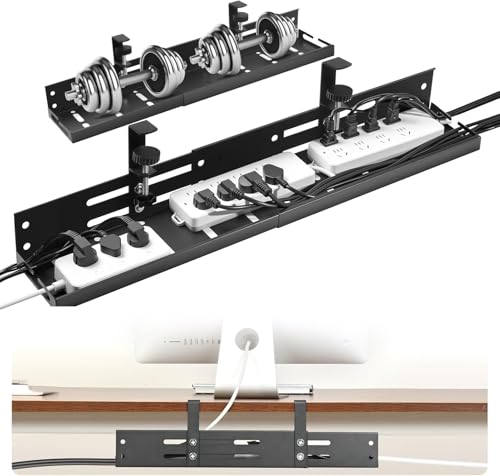
1. Under-desk metal cable tray with side opening: best value
A sturdy metal tray with a side-opening design, listed as holding about 15 lbs (around 7kg) and suitable for desks from roughly 1cm to 5cm thick. At £14.99 and rated 4.8 stars from more than 1,300 ratings, it is the default choice. A longer 25-inch (64cm) version of the same design is £18.69 (4.8 stars from 449 ratings) if you need to fit two power strips.

2. Two-pack under-desk cable trays with clamp mounts: best for two desks
Iron trays with a baked-varnish finish, clamp mounts and a listed capacity of up to 20 lbs (about 9kg). £14.44 for a pack of two, rated 4.4 stars from 152 ratings. Good if you run a desk each for work and home, or a main desk plus a side surface.

3. Univivi 36-inch no-drill cable tray: best for glass or metal desks
A long 36 x 5.5 x 5.5 inch tray with both no-drill clamp and screw-mount installation, listed as fitting wood, glass and metal desk tops. £31.44, rated 4.6 stars from 328 ratings. The right choice if a screw-in tray would not work on your desk.


4. Retractable no-drill cable tray for standing desks: best for sit-stand desks
An expandable tray from 43cm to 76cm long and 13cm wide with a clamp mount and anti-slip silicone pads, so no drilling or adhesive. £21.99, rated 4.4 stars from 15 ratings, so it is newer and less proven than the others. If you have an electric standing desk, remember you also need a flexible cable spine or sleeve so cables can extend as the desk rises.
5. D-Line cable tidy box: best floor-standing alternative
If a tray will not fit or you have a glass desk with nothing to attach to, a vented box on the floor hides a power strip and the worst of the slack. The D-Line is £9.99, rated 4.5 stars from more than 14,000 ratings, and is the brand to know in the UK.

How to fit an under-desk tray properly
The job takes about 30 minutes with a tape measure, a pencil and either a drill (screw-in) or rubbing alcohol (adhesive). Sit the tray at least 5cm in from the front edge so it does not bump your knees, and roughly centred under where most cables drop. Pre-fit the power strip and chargers on the floor first to confirm everything fits, fit the brackets, then strap the strip in with Velcro and gather slack with cable ties. If you use an adhesive tray, wait 24 hours before loading it.
Common installation mistakes
- Mounting too far back, so you cannot reach in to plug things in.
- Skipping a surge-protected power strip: once it is in a tray you rarely look at it again.
- Loading adhesive trays too soon.
- Forgetting heat: power strips and dense bundles of cables generate warmth, so open or vented designs are better.
Frequently asked questions
Will an adhesive tray hold long-term?
On a clean, dry, sealed wooden surface, yes. On unsealed melamine or anything dusty the bond degrades, so clean the surface properly first.
Can I fit a tray to an IKEA desk?
Yes, but check where the top is solid. Many flat-pack tops have a hollow core with solid edges, and that is where screws should go.
Do I need a separate cable spine for a standing desk?
Yes. The cable run from the tray to the wall has to extend and contract as the desk moves, or cables will yank out of the strip at full height or pile up at sitting height.
The bottom line
If you can drill, the value metal tray is the answer, and if you cannot, choose a no-drill clamp tray. For sit-stand desks, budget for a cable spine alongside the tray. Whichever you choose, installation is a one-hour job that pays back for years.