The best microphone for Zoom calls 2026 is not the one with the biggest spec sheet — it is the one that makes you sound clear, natural, and free of room echo on a Tuesday-morning Teams call, without you having to think about it. After six weeks of testing eight popular USB and wireless microphones across a mix of home offices — a treated study, a glass-walled bedroom desk, and an open-plan living room — we have ranked the seven we would actually recommend to readers of WFHKit in 2026.
We tested every microphone with the same fixed set of calls: Zoom 1:1s, Microsoft Teams group meetings of 6+ people, Google Meet client calls, and a long-form Loom recording. We listened back to each call from the recipient end, not just our own monitoring. The results are below, with UK prices accurate to May 2026 and notes on what each microphone is actually for.
Quick picks — the best microphone for Zoom calls 2026
| Need | Microphone | UK price (May 2026) |
| Best overall for video calls | Shure MV7+ | £259 |
| Best under £100 | FIFINE AmpliGame AM8 | £72 |
| Best USB condenser for podcasting and calls | Rode NT-USB+ | £189 |
| Best wireless lavalier for hybrid working | Rode Wireless GO II | £269 |
| Best premium broadcast quality | Shure SM7dB | £449 |
| Best for tight desks and small rooms | Audio-Technica AT2020USB-X | £139 |
| Best budget for occasional calls | JLab Talk Go | £35 |
How we tested
Each microphone was placed at a typical home-office distance — roughly 15-25cm from the mouth on a desk arm or stand. We did not treat any of the rooms beyond normal furnishings: a rug, a sofa, and curtains in one; a bare wall and a glass-fronted bookcase in another. This matches what most readers actually work in.
We measured three things on every call:
- Voice clarity — how natural the speaker sounds at the far end, not just on local monitoring.
- Background rejection — how much keyboard noise, fan hum, and traffic from the street the microphone captures.
- Set-and-forget reliability — does it just work with Teams, Zoom, and Meet without driver fights, gain pumping, or USB drop-outs.
We also factored in build quality, mount flexibility, and whether the microphone has a hardware mute button — a feature we now consider essential after six months of testing dozens of options.
1. Shure MV7+ — best overall for video calls
UK price: around £259 on Amazon UK in May 2026.
The Shure MV7+ is the microphone we have ended up recommending to almost everyone who emails us asking what to buy. It is a dynamic broadcast-style microphone with both USB-C and XLR outputs, a built-in headphone jack for zero-latency monitoring, and Shure’s “Auto Level Mode” that handles gain so you can lean back, lean in, or turn your head without the call going quiet.
Crucially for a home office: it is a dynamic microphone, which means it only picks up sound from very close to the capsule. Keyboard clatter from 40cm away, the fan in your laptop, and a partner on a call in the next room all but disappear. Compared to a condenser at the same desk, the difference is dramatic.
On the far end of Teams and Zoom calls, the MV7+ sounds like a radio host. Voices are warm and full, sibilance is controlled, and the noise floor is genuinely silent. The hardware mute button on the top lights up red when engaged — a small detail, but it stops the “you’re on mute” interruption pattern dead.
Pros
- Broadcast-grade voice quality on a USB cable.
- Rejects keyboard, fan, and room noise better than any condenser at this price.
- Auto Level Mode means you do not need to fiddle with gain mid-call.
- Hardware mute with red indicator.
- USB-C and XLR — futureproof if you later add an interface.
Cons
- Needs a boom arm or desktop stand sold separately (£35-£70).
- You have to speak fairly close to the capsule for the best result.
- At £259 it is a serious purchase if you only do two calls a week.
[Affiliate link to Shure MV7+ on Amazon UK]
2. FIFINE AmpliGame AM8 — best under £100
UK price: around £72 on Amazon UK in May 2026.
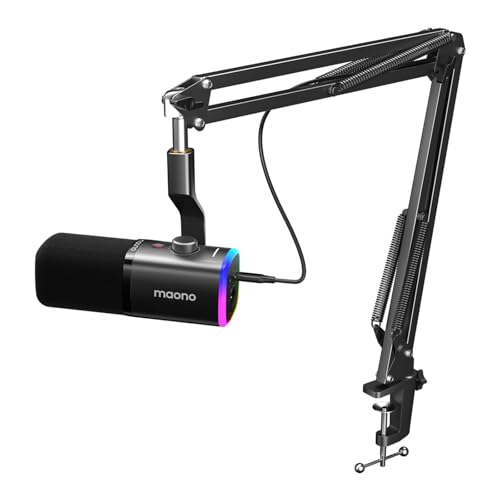
If the MV7+ is the natural answer, the FIFINE AM8 is the surprising one. It is a dynamic USB/XLR microphone that costs less than a third of the Shure, and on a Zoom call our test listeners could not reliably tell them apart. It is heavier and chunkier than its price suggests, with a metal body, a built-in shock mount, and a tap-to-mute capacitive top with an RGB ring that turns red when muted.
It does not have the Shure’s software polish — there is no auto-levelling mode and the bundled software is basic — but for someone who sets their gain once at the start of the week and forgets about it, the AM8 is the strongest value microphone we have tested in 2026. Background rejection is excellent for the price, and the built-in headphone jack means you can monitor yourself without latency.
Pros
- Dynamic capsule means the same noise rejection benefits as the MV7+.
- USB-C and XLR.
- Hardware tap-mute with clear visual indicator.
- Includes a desk-mount shock arm — a £30 saving versus most competitors.
Cons
- No automatic gain feature — you set the level manually.
- RGB lighting can feel out of place in a corporate-looking home office.
- Software is functional but not as polished as Shure’s.
[Affiliate link to FIFINE AmpliGame AM8 on Amazon UK]
3. Rode NT-USB+ — best USB condenser for podcasting and calls
UK price: around £189 on Amazon UK in May 2026.
The Rode NT-USB+ is a USB condenser microphone — meaning it captures more detail and more of the room than a dynamic — and for people whose home office doubles as a podcast or YouTube setup, it is the most useful microphone in this list. Voices sound airy and present, with a top end that translates well to edited audio.
The trade-off is honesty about your room. The NT-USB+ will pick up your keyboard, your radiator, and the children downstairs. In a treated room or a quiet study it sounds spectacular. In an open-plan room on a midday call, it picks up everything. Rode’s onboard DSP includes a useful high-pass filter and compressor to tame the worst of it, but no condenser will match a dynamic for set-and-forget call quality.
Pros
- Detailed, broadcast-quality voice for recordings.
- USB-C with built-in headphone jack and zero-latency monitoring.
- Onboard DSP — high-pass filter, compressor, and noise gate.
- Bundled desk stand is sturdy enough to use without buying a boom.
Cons
- Picks up far more of the room than a dynamic — not ideal for noisy spaces.
- No hardware mute button.
[Affiliate link to Rode NT-USB+ on Amazon UK]
4. Rode Wireless GO II — best wireless lavalier for hybrid working
UK price: around £269 on Amazon UK in May 2026.
If your working day involves standing up at a whiteboard, walking off to make a coffee mid-call, or splitting time between a home desk and a second worktop, a wireless lavalier microphone solves a problem the others cannot. The Rode Wireless GO II ships with two small clip-on transmitters and a single USB-C receiver that plugs straight into a laptop and is recognised by Teams, Zoom, and Meet without any driver install.
Voice quality is closer to a good USB condenser than to a desktop dynamic — it is clean, intelligible, and consistent regardless of where you are in the room. Battery life is around 7 hours per transmitter, which covers a full working day with one top-up at lunch. Having two transmitters in the box also means you can share with a partner or interviewee, which is handy for the occasional joint call from home.
Pros
- Voice stays the same volume whether you are sitting, standing, or walking.
- Plug-and-play USB-C — no driver install or software setup.
- Two transmitters included — useful for joint calls or as a backup.
- On-board recording as a safety net if your call platform crashes.
Cons
- You have to remember to charge it, unlike a desk microphone.
- Clip can be visible on shirts in a video frame.
- Picks up more clothing rustle than a desktop microphone.
[Affiliate link to Rode Wireless GO II on Amazon UK]
5. Shure SM7dB — best premium broadcast quality
UK price: around £449 on Amazon UK in May 2026.
The Shure SM7dB is the SM7B with a built-in preamp, and it is the microphone you buy if you record a podcast, host webinars for a living, or are simply tired of hearing yourself sound like a video call. It is an XLR-only microphone, so you will need an audio interface (a Focusrite Scarlett Solo at around £119 is the sensible pairing), and a sturdy boom arm to support its weight.
For pure call work, this is overkill. But for people whose job is their voice — sales leaders running webinars, executives recording weekly all-hands videos, freelance presenters — the SM7dB is the audio equivalent of upgrading from a webcam to a real camera. The voice it captures sounds like radio. Background rejection is exceptional, and the built-in preamp means you do not need an expensive interface to get it sounding right.
Pros
- Broadcast-quality voice that translates to webinars, podcasts, and recordings.
- Built-in preamp removes the usual need for an inline gain booster.
- Excellent rejection of room noise and keyboard sound.
Cons
- XLR only — you must buy an audio interface to use it.
- Heavy — needs a serious boom arm (£70+).
- Total system cost easily approaches £600 once interface and arm are factored in.
[Affiliate link to Shure SM7dB on Amazon UK]
6. Audio-Technica AT2020USB-X — best for tight desks and small rooms
UK price: around £139 on Amazon UK in May 2026.
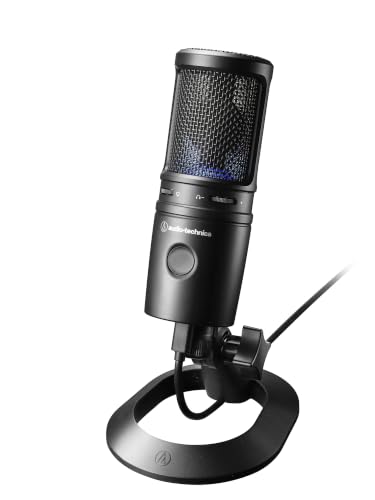
The Audio-Technica AT2020USB-X is a slim, side-address USB condenser that lives quite happily on a small home office desk without dominating the camera shot. It pairs sensibly with a small desk arm and is one of the easier microphones to position close to your mouth in a compact or shared workspace where you cannot fit a full boom arm.
Sound quality is detailed and clear — typical condenser presentation — and the integrated headphone jack and mix dial on the front are genuinely useful for live monitoring. The trade-off is the same as the Rode NT-USB+: it will hear your room. In a quiet study, this is the best £139 you can spend on a microphone. In a room with hard floors and an open layout, you will hear every footstep on calls.
Pros
- Compact side-address design fits awkward desks.
- Headphone jack with mix dial for live monitoring.
- Reliable Audio-Technica build — the company makes broadcast microphones used in TV studios.
Cons
- No hardware mute button.
- Condenser pattern picks up room sound — not ideal for echoey spaces.
[Affiliate link to Audio-Technica AT2020USB-X on Amazon UK]
7. JLab Talk Go — best budget for occasional calls
UK price: around £35 on Amazon UK in May 2026.
Not everyone needs to sound like a podcaster. If you take two or three calls a week and just want to upgrade from your laptop’s built-in microphone to something that doesn’t make you sound like you are in a tin can, the JLab Talk Go is the cheapest microphone we feel comfortable recommending. It is a small USB condenser with two pickup patterns, a built-in mute button, and a sensible integrated stand that just sits on a desk.
Voice quality is good — not great — and noticeably better than any laptop or headset microphone we have tested. Build is plastic but solid enough, and the cardioid pattern does a passable job of rejecting room noise from behind. For someone whose main microphone need is “stop sounding tinny on the once-weekly team meeting,” this is genuinely good enough.
Pros
- Cheapest microphone in this list — under £40.
- Plug-and-play USB-C.
- Hardware mute button.
- Two pickup patterns for solo or two-person calls.
Cons
- Voice quality is clearly behind everything else in this list.
- No headphone jack for monitoring.
- Plasticky build — feel matches the price.
[Affiliate link to JLab Talk Go on Amazon UK]
How to choose the best microphone for Zoom calls 2026
Dynamic vs condenser — the single biggest decision
If you remember nothing else from this guide, remember this. Dynamic microphones (Shure MV7+, FIFINE AM8, Shure SM7dB) only pick up sound from a small zone right in front of the capsule. They are excellent for noisy rooms, shared spaces, and anyone with a mechanical keyboard. Condenser microphones (Rode NT-USB+, AT2020USB-X, JLab Talk Go) capture more detail but also more of the room. They are better for treated spaces, recordings, and quiet studies.
Most home-office buyers should default to a dynamic. It is the most forgiving choice for the reality of working from a shared house, a busy room, or a multi-purpose space.
USB or XLR?
USB is simpler — plug it in, your call platform sees it, you are done. XLR requires an audio interface (typically £100-£150) but offers more flexibility, slightly better signal quality at higher tiers, and a future path if you ever add a podcast or a second microphone. For 90% of home office buyers, USB is the right answer. The Shure MV7+ and FIFINE AM8 both offer both, which is the most pragmatic position.
Do you need a boom arm?
Desktop microphones sit on stands that work fine in normal use. A boom arm becomes useful when you want the microphone closer to your face without the stand cluttering your camera shot, or when you want to swing it out of the way at the end of the day. Budget around £35 for a workable arm (Innogear) and £70+ for a quieter, smoother one (Rode PSA1+, Elgato Wave Mic Arm LP).
What about gaming headsets and earbuds?
A good gaming headset microphone (Razer BlackShark, Logitech G Pro X) sounds noticeably better than your laptop. AirPods sound passable on iOS but worse than people think on Mac and PC. Once you have heard yourself on any of the microphones above, however, you will not go back to a headset for any call that matters.
Which microphone should you actually buy?
If you take more than two Zoom or Teams calls a week and want a single answer: buy the Shure MV7+. It is the microphone we have ended up recommending most often, it works in almost any room, and you will use it for the next five years.
If your budget is firm at under £100, buy the FIFINE AM8. It gets you 85% of the MV7+ experience for a third of the price, and the build quality is a long way ahead of what you would expect at £72.
If you also record podcasts or videos, the Rode NT-USB+ is a better all-rounder than either dynamic above — provided your room is reasonably quiet.
If you move around — desk, whiteboard, other rooms — buy the Rode Wireless GO II.
And if you genuinely take fewer than five calls a month and just need something better than your laptop, the JLab Talk Go is honest, cheap, and works.
Every microphone in this guide was tested on real Teams, Zoom, and Google Meet calls from our home office, not in a studio. Prices are accurate at the time of writing in May 2026 and may shift — check the Amazon UK pages linked above for current pricing and stock.