Damp is the British home office’s least glamorous problem. Condensation running down the inside of the window each morning, a musty smell that returns however often you air the room, black spots creeping along the sealant, and paperwork that feels faintly soft to the touch. Converted garages, garden rooms and north-facing box rooms are the usual suspects.
It is also a problem worth taking seriously, because damp air affects more than comfort. Mould spores are a genuine respiratory irritant in a room you sit in for eight hours a day, and sustained high humidity is not kind to electronics, books or a wooden desk. A small dehumidifier is the direct fix, and running one is cheaper than most people assume. This guide covers the two competing technologies, the specifications that matter, and the best small dehumidifiers for a UK home office.
First, measure and diagnose
Get a hygrometer before you spend anything – they cost under £10. Comfortable indoor humidity is roughly 40–60%. Above 60% you are in condensation and mould territory and a dehumidifier is justified; above 70% it is urgent. Below 55% and the damp you are seeing probably has a different cause.
That distinction matters because a dehumidifier treats symptoms. If water is entering through a failed damp-proof course, a leaking gutter or a cracked render, no amount of dehumidification will fix it – you will simply run a machine forever against an incoming tide. Persistent damp on a single wall, tide-marks near the skirting, or damp that is worse after heavy rain all point to a building fault worth investigating properly. Condensation on windows and general mustiness across the whole room, by contrast, is exactly what a dehumidifier is for.
Compressor or desiccant? The one real decision
Compressor (refrigerant) dehumidifiers
These work like a fridge: air passes over a cold coil, moisture condenses out, and the dry air is returned to the room. They are efficient and cheap to run in warm conditions, and they are the right choice for a heated room that stays above about 15°C.
Their weakness is cold. Below roughly 15°C, extraction drops off sharply, and the coil starts icing up, forcing defrost cycles during which the machine does nothing useful. In an unheated garage office in January, a compressor unit struggles. They are also the noisier of the two types, because there is a compressor cycling on and off.
Desiccant dehumidifiers
These pass air over a moisture-absorbing rotor, which is then gently heated to drive the water off. Performance barely changes with temperature, so they work just as well at 5°C as at 20°C – which makes them the obvious choice for garden offices, garages and any unheated space.
They are lighter, usually quieter in character (a steady hush rather than a cycling compressor), and they return slightly warmed air to the room, which is a small bonus in winter. The trade-off is electricity: a desiccant unit typically draws 300–650W continuously, against 150–300W cycling for a compressor. In a warm room the compressor wins on running cost; in a cold one the desiccant wins because the compressor barely works at all.
What else to look for
- A humidistat. Set a target of 50–55% and let the machine cycle itself off. Without one it runs constantly, wasting electricity and over-drying the room.
- Extraction rate matched to the room. A single office does not need a 20-litre-per-day whole-house unit. Something in the 8–12L/day range is plenty, and a ‘mini’ Peltier unit rated at 300–750ml/day is only suitable for a wardrobe or a very small cupboard – not a room.
- Tank size, or continuous drainage. A 2-litre tank in a genuinely damp room needs emptying daily. If you can site the unit near a drain or window, a continuous drain hose removes that chore entirely.
- Noise at working speed. Under 40dB is realistic for the quieter models; a compressor kicking in mid-call is noticeable.
- Laundry mode, if the office doubles as the place clothes dry in winter – it runs at maximum without cycling.
- Auto-restart, so it resumes its settings after a power cut rather than sitting idle for a week.
The best small dehumidifiers for a home office
Best overall: MeacoDry Arete One 10L
Meaco’s Arete range has become the default UK recommendation for good reason. The 10-litre model is well matched to a single room, its humidistat is accurate, it is among the quietest compressor units available, and it includes HEPA filtration so it doubles as a basic air cleaner. Controls are simple and the display dims fully.
It is a compressor unit, so it wants a room that stays reasonably warm. In a heated home office that is exactly the right choice.

- 2-in-1 DEHUMIDIFIER & AIR PURIFIER – This quiet dehumidifier not only controls humidity by removing up to 10L of water per day, but enhances your living environment further with a medical grade H13 HEPA filter for air cleaning; keeping it fresh and clear of nanoparticles such as dust, dander, pollen and other allergens.
- MOST ENERGY EFFICIENT DEHUMIDIFIER AVAILABLE - Has low power consumption and optimised energy usage, making it cost-effective and practical for daily use to keep condensation, damp and mould problems at bay. Low energy costs of 3p/h based on 24.5p/kWh cost per hour to deal with condensation, mould and damp in smaller sized homes.
- SOLUTION FOR DRYING WASHING INDOORS - Effective at air drying wet laundry. Uses considerably less electricity than tumble dryers. Dedicated laundry mode runs for six hours before switching itself off to save energy.
- INTELLIGENT DESIGN - The Arete One energy saving dehumidifier has excellent features that make it stand out, including smart laundry mode, night mode, smart humidity mode, hidden castors, hidden carry handle, cable tidy and a 2.5L front loading water tank. With a gentle hum at only 35dB sound level, this model is twice as quiet as the industry standard.
- WHISPER QUIET - The result of 5 years of development, the MeacoDry Arete One Low Power Dehumidifier 10L is our quietest, most energy efficient model yet. No other domestic dehumidifier brand offers this as standard.
Best for cold or unheated rooms: EcoAir DD1 Simple MK3
The desiccant answer, and the one to buy for a garage conversion, a garden office or any room that drops close to freezing overnight. Extraction holds up at low temperatures where a compressor would be idling through defrost cycles, it is light enough to carry one-handed, and the warm air it returns takes a slight edge off a cold room.
It uses more electricity than a compressor unit does in a warm room – but in a cold room it is the only one of the two actually doing the job.
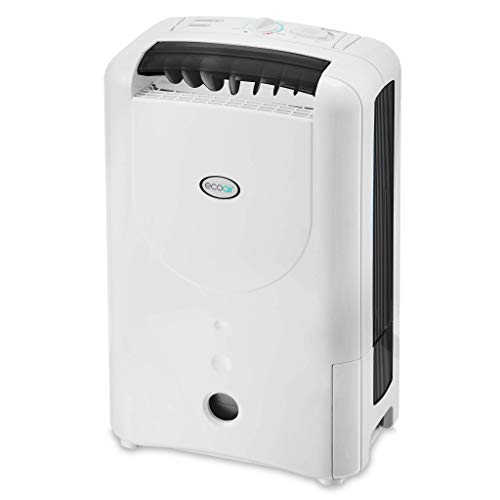
- COMPACT DEHUMIDIFIER - Small but powerful extracts 7.5 Litres per day
- SILVER NANO ANTI BACTERIALFILTER - is easy to remove, sliding in and out easily for quick regular cleaning.
- QUIET OPERATION - Only 34 dBA
- ROTARY DIAL - Easy to use manual rotary control dial
- Ideal for room area up to 60m²

Best value: Pro Breeze 12L Compressor Dehumidifier
Noticeably cheaper than the Meaco while offering similar extraction, a humidistat and a continuous drain option. Build quality and the refinement of the controls are a step down, and it is somewhat louder in operation, but the fundamentals are sound and it does the job in a heated room.
A sensible choice if the budget is the deciding factor and the office is not a room you take calls in constantly.
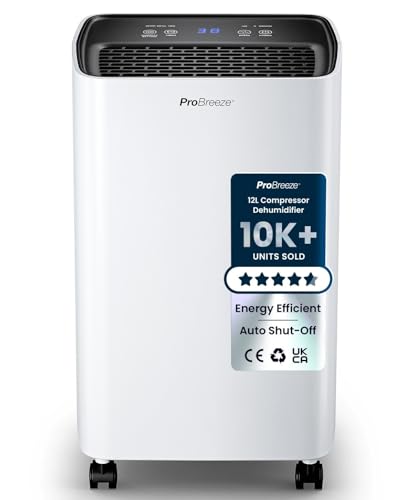
- LOW ENERGY CONSUMPTION - This energy-efficient 12L/day dehumidifier by Pro Breeze features a powerful compressor, a 24-hour on/off timer and an energy saving auto shut-off system - helping you to reduce energy bills. It's ideal for damp, black mould, condensation and moisture in homes. Running cost as low as 5p per hour.
- DRY YOUR CLOTHES QUICKER: One of the most advanced dehumidifiers for home, the Pro Breeze dehumidifier uses an efficient air compressor and features a continuous drying mode, helping you to dry your clothes quicker without putting the heating on or using an expensive tumble dryer - perfect for use in your laundry room.
- SAME SMALL SIZE, MAXIMUM POWER: With an upgraded capacity but same size, this small dehumidifier extracts up to 12 litres of water per day - an impressive amount of moisture compared to other condensation absorbers on the market of the same size. The large 2L water tank automatically shuts off when full, and a drainage hose is included for continuous operation.
- SET YOUR DESIRED HUMIDITY: The humidity sensor with LED light indicators measures the ambient room humidity and displays it on the digital LED display, allowing you to set desired humidity between 30-90%. Once this has been reached, the compressor will turn off to conserve energy.
- PORTABLE INTERIOR DEHUMIDIFIER: Less intrusive than a dishwasher at up to <42dB, this is the perfect dehumidifier for bedroom or home office. Smaller than your classic microwave, it comes with 4 wheels for easy transport between rooms and storage in cupboards, basements, rooms and tight spaces.
Best for a cupboard or small enclosure: Pro Breeze 500ml Mini Dehumidifier
Worth including mainly to set expectations correctly. These small Peltier-effect units extract a few hundred millilitres a day, draw very little power and make almost no noise. In a wardrobe, a cupboard, a caravan or under a sink, that is genuinely useful.
In a room, it is not enough – it will run continuously and change nothing. Do not buy one expecting it to fix a damp office.
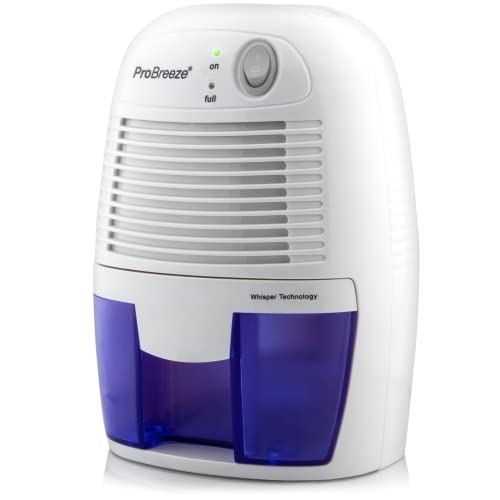
- Removes 250ml Per Day: Features next-generation Peltier Technology capable of removing up to 250ml of water per day with a 500ml water tank capacity. Ideal for rooms up to 2200 cubic feet (220 sq ft). Energy efficient dehumidifier with running cost as low as 1p per hour (November 2022).
- More Powerful & Efficient: This highly efficient dehumidifier uses up to 45% less energy per hour than similar models and has an operating temperature range of 15-30°C. Perfect for high humidity in your home, kitchen, bathroom, caravan or garage.
- Ultra-Quiet Operation: Engineered with innovative Thermo-Electric Cooling Technology (Peltier) which operates without a compressor meaning whisper quiet operation in bedrooms, bathrooms and offices.
- Intelligent Auto Shut-off: When the water tank reaches maximum capacity the dehumidifier will automatically shut off and the LED light will turn on, indicating the water tank needs draining.
- Easy To Empty & Clean: The top of the water tank is fully detachable providing a quick and easy way to empty and clean the tank. Features a water level viewing portal.
Comparison at a glance
| Model | Type | Extraction | Works when cold | Approx. price |
| MeacoDry Arete One 10L | Compressor | 10L/day | Poorly | £150–£180 |
| EcoAir DD1 Simple MK3 | Desiccant | 7–8L/day | Yes | £160–£200 |
| Pro Breeze 12L | Compressor | 12L/day | Poorly | £95–£120 |
| Pro Breeze Mini | Peltier | ~500ml/day | Poorly | £30–£40 |
Getting the most from it
Close the door. A dehumidifier working on one room with the door shut will bring humidity down within a day; the same machine with the door open is trying to dry the whole house and will simply run indefinitely. Position it centrally with clearance around the intake and outlet rather than jammed against a wall.
Run it hardest in the first week to pull the room’s fabric back to a normal moisture level, then set the humidistat to 50–55% and let it cycle. Empty the tank promptly – standing water in a warm room is its own hygiene problem – and clean the filter monthly, since a clogged filter cuts extraction badly. And keep tackling the sources: dry washing elsewhere, ventilate after showers, and open the window for ten minutes each morning even in winter.
Which dehumidifier should you buy?
The decision is almost entirely about temperature. If your office is inside the heated envelope of the house and stays above 15°C, buy the MeacoDry Arete One 10L – it is quiet, accurate, cheap to run and includes useful filtration. If your office is a garden room, a garage conversion or anywhere that gets genuinely cold, buy the desiccant EcoAir DD1 instead, because a compressor unit will disappoint you every winter.
The Pro Breeze 12L is the value pick for a heated room where noise is not critical. And ignore the mini Peltier units for room use entirely – they are cupboard devices sold with room-sized ambitions.
One final caution: if the damp is confined to one wall, worsens after rain, or leaves tide-marks near the skirting, get the building looked at before buying anything. A dehumidifier manages moisture in the air; it cannot stop water coming in.