The economics of working from home in a British winter are annoying. Heating an entire three-bedroom house to keep one person warm in a box room is enormously wasteful, but sitting still at a desk for eight hours in an unheated room is genuinely unpleasant – and cold hands make typing miserable long before you feel cold anywhere else.
A space heater solves the right problem: heat the ten cubic metres you occupy rather than the two hundred you do not. Choose well and you can keep the central heating off through the working day and still be comfortable. Choose badly and you get a fan heater that costs a fortune to run, drones through every call, and dries the air out until your throat hurts. This guide covers the best space heater types for a home office, the running-cost maths, and the picks worth your money.
The running-cost maths nobody puts on the box
Start here, because it reframes everything else. All electric heaters are 100% efficient at converting electricity into heat – a 2kW fan heater and a 2kW oil-filled radiator produce exactly the same amount of heat from the same electricity. Any advert claiming one electric heater is more efficient than another is misleading you.
What differs is how quickly the heat arrives, where it goes, and therefore how long the heater actually needs to run. At the current price-cap electricity rate of 26.32p per kWh, a 2kW heater running flat out costs a little over 52p an hour, or about £4.20 over an eight-hour day. Running the same heater at 1kW, or at 2kW with a thermostat that cycles it on a third of the time, costs a third to a half of that. The heater that costs least to run is the one whose thermostat is good enough to keep it switched off most of the time.
Compare that with central heating: a gas boiler heating the whole house typically costs considerably more per hour than a 1kW heater warming one room, so for a single person working alone, the space heater usually wins clearly. If two or three people are home in different rooms, the maths flips back towards central heating.
The four types, and which suits a desk
Oil-filled radiators
A sealed radiator with oil warmed by an internal element. Slow to heat up – twenty minutes or so – but it holds warmth and keeps radiating after the thermostat cuts the power, so it cycles less often and delivers a very steady, even room temperature. Crucially for an office, it is completely silent: no fan, no clicking beyond the occasional thermostat tick.
Downsides are bulk and weight, and the wait when you sit down at a cold desk. For someone working a full day in the same room, though, this is usually the right type.
Ceramic fan heaters
Instant warmth from a heating element and a fan. Cheap, light, and heat a small room in minutes. The problem is obvious: there is a fan, so there is noise, typically 45–50dB, which your microphone will pick up and your colleagues will hear. They also blow dust around and dry the air noticeably.
Best used as a fast top-up for the first fifteen minutes of the morning rather than as an all-day heater.
Infrared and radiant panels
These heat objects and people directly rather than warming the air, in the same way sunlight feels warm on a cold day. Silent, instant, and very efficient in the specific sense that you feel warm without needing to raise the whole room’s air temperature. In a draughty room or a garden office with poor insulation, that is a real advantage – warming the air in a leaky room is throwing money outside.
The limitation is line of sight. Step out of the beam and the warmth stops immediately. Panel heaters mounted on a wall or under a desk work well for a seated worker who does not move much.
Under-desk and personal heaters
The most targeted option: a small radiant panel or heated footrest under the desk warming your legs and feet, typically drawing 100–400W rather than 2,000W. Since cold feet are what most desk workers actually notice, this can be all you need, at roughly a tenth of the running cost of a room heater.
It will not make a cold room feel warm if you get up and walk around, and it does nothing for cold hands. As a supplement, or for a mildly cool rather than genuinely cold room, it is the cheapest comfort available.
The best space heaters for a home office
Best overall: De’Longhi Dragon 4 TRD40820T Oil-Filled Radiator
The sensible default for a home office. It is silent, its thermostat is accurate enough to hold a room within about a degree, and the thermal mass means it spends much of the day switched off while the room stays comfortable. Three heat settings let you run it at 1kW rather than 2.4kW once the room is up to temperature, which is where the running-cost savings actually come from. The 24-hour timer means it can warm the room before you sit down.
It is heavy and it takes twenty minutes to get going. Use the timer and neither matters.
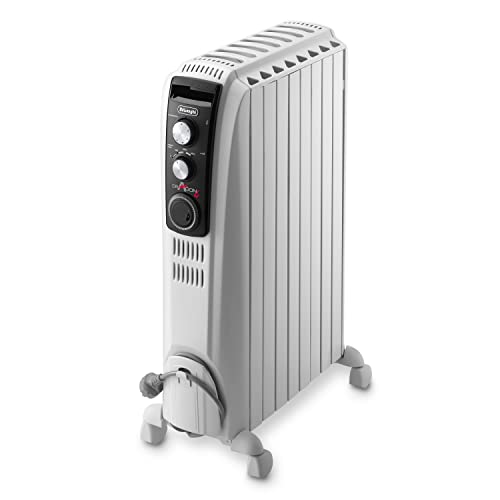
- The enhanced chimney effect accelerates hot air through vents for effective heating
- 2 kW heat output and three heat settings; Rated voltage/Frequency (V - Hz): 230~50
- Elegant design and pure brilliant White finish
- Pre-assembled easy wheels and carry handle for easy transportation
- Thermostat and anti-frost device with 24 hrs mechanical timer
Best value: Dimplex ECR20TIE Oil-Free Radiator
A lighter, faster-warming take on the column radiator that uses a thermal fluid alternative rather than oil, so it reaches temperature in a few minutes instead of twenty while staying silent. It costs less than the De’Longhi and weighs a good deal less, which matters if the heater moves between rooms.
The thermostat is cruder and the heat is less even over a long day. For a smaller room, or occasional rather than daily use, it is the better buy.
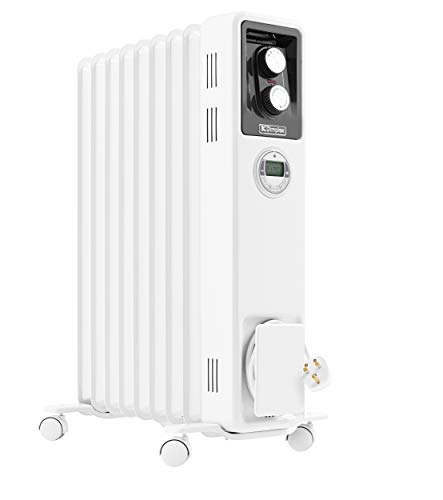
- DIMPLEX 2KW ECO LARGE RADIATOR - A compact yet versatile home heater with near silent operation, oil free energy saving technology, electronic 24 hour timer, LCD screen, thermostat and 3 heat settings
- PORTABLE FREE STANDING RAD - Compact oil free eco heater, ideal for heating large rooms such as a lounge, conservatory, kitchen or bedroom; efficiently heats your space whilst using less electricity
- RAPID AND RESPONSIVE - Oil-free technology has up to 30% faster warm up and uses up to 9% less energy compared to oil-filled*. Easy to use, with no maintenance and a low carbon footprint
- 2 KW HEAT OUTPUT – A space saving yet powerful room heater, ideal for cold weather. Lightweight and great for top-up heating. On castor wheels with cable tidy; easy to move around your home or office
- PLUG IN AND GO – 1.8m cable and 3 year guarantee included. Brought to you by Dimplex, the trusted name for energy efficient electrical heating, ventilation and cooling for over 70 years

Best for fast heat: Dreo 1500W Oscillating Ceramic Heater
If you need a cold room usable in five minutes, a good ceramic heater is the honest answer, and Dreo’s are meaningfully quieter than the supermarket norm – close to 40dB on low, with a genuine thermostat rather than a simple on/off. Oscillation spreads the heat rather than roasting one side of you.
It is still a fan, and it is still audible on a call. Use it to take the edge off first thing, then switch to something silent.
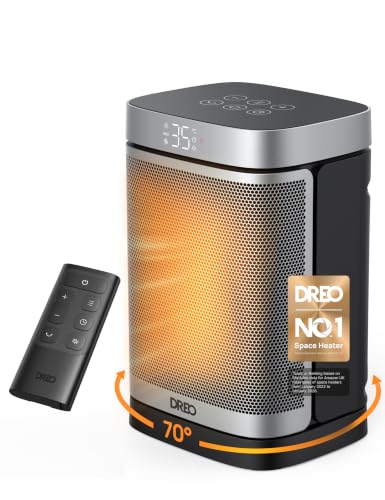
- Small but Mighty: Adopting advanced PTC ceramic heating, this 26.2cm compact space heater gives off surprisingly powerful heat to get you cozy and warm in no time, fitting perfectly on your desktop, counter nightstand. The hidden carry handle makes it easy to move between bedroom, bathroom, study room, kitchen home, office, indoor.
- Quick Heating: Powered by DC motor and 9 blades, this ceramic heater outputs 1500W high-powered PTC ceramic heating, much faster than other traditional electric heaters using AC motor and 3 blades. 3-35℃ adjustable electronic thermostat and LED Display make it a breeze to customize your ambient temperature in cold.
- 70° Oscillating Warmth: Superior to other small heaters, this 70° wide oscillating heater equipped with exclusive trackball system, which help the heat cover more areas in a quiet and smooth way. The working noise level down to 40dB, 1-12h timer as well as display auto dim-off make it more user friendly at night.
- Safe to Use: Overheat and tip-over protection provides ultimate security. Reinforced prongs, ABS flame-retardant materials, and upgraded rubber power cord make your home heating safe and stress-free. Multiple safety protection is designed superior to other portable heaters in detail to meet your safety heating need. Exclusive removable washable filter brings fresh warm air for you as well as meet with environment friendly design idea.
- Energy Saving: Features 4 modes (High, Low, ECO, Fan) to personalize your comfort. Energy-saving ECO mode adjusts its power based on the temperature around to keep you warm while helping cut down on heating costs.
Best budget: under-desk heated floor mat
Around £30, drawing a few hundred watts, and aimed squarely at the actual symptom – cold feet. For anyone whose office is merely chilly rather than genuinely cold, this is the cheapest possible fix to run: pennies a day rather than pounds. Look for one with an automatic shut-off timer and a surface that does not exceed a safe touch temperature.
It heats you, not the room. If your office is properly cold, treat it as a companion to one of the heaters above rather than a replacement.

- KEEPS TOES WARM: Our warm foot pads are made of materials with excellent heating properties that heat quickly. There is no need to remove your shoes, just put your feet on the pad. Whether at home or work, it will keep your feet and toes warm and comfortable.
- EASY TO USE: Foot switch with temperature display. You don't need to bend over, just open it with your feet. Step and hold for more than 2 seconds to switch on or off. In the power-on state, lightly step on to set any of the 7 temperatures.
- HIGH-QUALITY MATERIAL: The surface material of the heating pads is floor leather which is waterproof, wear-resistant, and high temperature resistant, and has excellent heat transfer performance. There are non-slip particles on the back of the product to prevent the product from moving.
- SAFE & ENERGY SAVING: The heating mat uses only 55 watts, which is just a fraction of the energy used by traditional space heaters. It can be used normally at a voltage of 110-240V and has the function of temperature memory & temperature overheat protection. The product will auto-off after 3 hours.
- PORTABLE & VERSATILE USE: This small heated floor mat is easy to carry, can be rolled up for convenient, easy to store. Convenient to use in many life scenes: kitchen, office, dining room, living room, study, bedroom and other living places.
Comparison at a glance
| Model | Type | Silent? | Time to warm | Approx. price |
| De’Longhi Dragon 4 | Oil-filled | Yes | 15–20 min | £120–£170 |
| Dimplex ECR20TIE | Thermal fluid | Yes | 3–5 min | £80–£110 |
| Dreo ceramic heater | Ceramic fan | No (~40dB) | 1–2 min | £50–£80 |
| Under-desk heated mat | Radiant | Yes | 2–3 min | £25–£35 |
Safety, briefly but seriously
- Never run a space heater from an extension lead or a multi-way adaptor. A 2kW heater draws close to 9 amps continuously and cheap extension leads overheat. Plug it directly into a wall socket.
- Check for tip-over cut-off and overheat protection – both should be standard on anything sold new in the UK, and their absence is a reason to walk away.
- Keep at least a metre of clearance in front, and never drape anything over a heater to dry it.
- Do not run a heater unattended overnight. Use the timer instead.
- If a heater smells of hot dust for more than the first ten minutes of the season, switch it off and investigate.
Which space heater should you buy?
For most home offices, an oil-filled radiator like the De’Longhi Dragon 4 is the right answer. It is silent, so it never interferes with a call; its thermal mass and decent thermostat mean it runs less than its wattage suggests; and the timer removes the only real drawback, the slow warm-up. Set it to come on half an hour before you start and it simply looks after the room all day.
If your office is a garden room, a garage conversion or anywhere with poor insulation, buy an infrared panel instead – warming you directly is the only approach that works when the room itself leaks heat. If you just need to knock the chill off a room that is otherwise fine, an under-desk heated mat costs almost nothing to run and fixes the symptom most people actually feel. And keep a ceramic fan heater around only as a fast starter, not as your main heat.
Whatever you choose, the biggest saving is not the heater – it is the door. Close it, block the draught underneath, and you will need a fraction of the heat you otherwise would.