Two years into working from home, most people reach the same uncomfortable realisation: the commute they were quietly relying on for daily movement has gone, and nothing has replaced it. A walk to the station and back was perhaps 4,000 steps without thinking about it; now the longest journey of the day is to the kettle.
The two products sold as the fix are the standing desk and the under-desk treadmill. They are usually discussed as rivals, but they solve overlapping and different problems, and one is a much bigger commitment than the marketing suggests. This guide compares them on health effect, cost, space, noise and whether you will still be using them in six months.
The short version
| Standing desk | Under-desk treadmill |
Typical UK cost | £250–£600 (electric, decent frame) | £250–£500, plus a standing desk to use it under |
Floor space needed | Desk footprint only | Desk footprint plus about 1.4m × 0.6m clear floor |
Steps added per day | None directly | 5,000–12,000 realistically |
Type while using it? | Yes, comfortably | Yes, slower with more typos at first |
Calls | Yes | Video and audio yes; you will breathe audibly |
Noise | Silent (hum when raising) | 45–65 dB, plus footfall through the floor |
Setup friction | Press a button | Roll out, step on, adjust (30 seconds) |
Best for | Breaking up sitting, back comfort, alertness | Replacing lost daily movement |
If you can only buy one thing and you sit all day with a sore lower back, buy the standing desk. If you already have a sit-stand desk and now move 3,000 steps a day instead of 9,000, the treadmill fixes that. A treadmill without a height-adjustable desk is close to useless, which is the single most important catch to understand before spending anything.
What a standing desk actually does
A sit-stand desk lets you alternate posture through the day. It is not exercise: standing burns roughly 8–12 extra calories an hour compared with sitting. What it delivers is comfort. Research on prolonged static sitting points consistently to discomfort, particularly lower-back pain, improving when people can change position, with modest reductions in reported back and neck discomfort and small gains in afternoon energy. Standing for the first hour after lunch is the most useful habit it enables. Nobody stands for eight hours.
Where standing desks disappoint people
- Standing all day hurts too: an anti-fatigue mat is not optional for long stretches.
- Cheap frames wobble: under about £200 for an electric dual-motor frame tends to shake when you type, which is why the desk ends up permanently sitting.
- Cable management punishes you: if cables tug on every height change, you stop bothering.
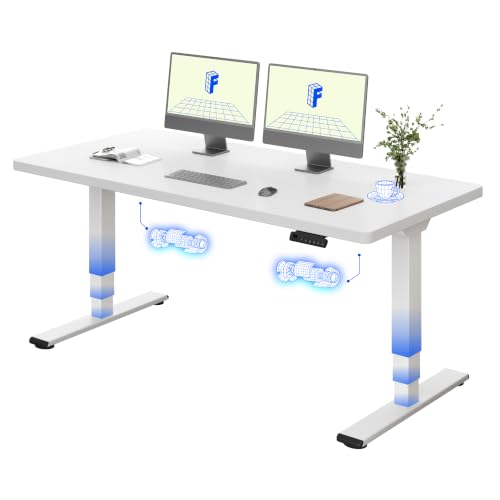
Our picks: the FlexiSpot E5 is a solid dual-motor, three-stage electric desk with a one-piece 160 × 80 cm top, four memory presets and anti-collision, £269.99 on Amazon UK (4.6 stars from 33 ratings). The FlexiSpot anti-fatigue mat is 2 cm thick, £48.99 (4.6 stars from 1,108 ratings), and is the one we would stand on in front of it.


What an under-desk treadmill actually does
A walking pad is a low, motorised belt with no handrails, designed to sit under a raised desk and run at 1–6 km/h. Almost everyone settles between 2 and 4 km/h, a genuine amble. It adds movement rather than just changing posture: an hour at 3 km/h is roughly 3,000–3,500 steps and about 130–200 kcal depending on weight. Two calls a day on the belt takes a desk worker from 3,000 steps back towards the 8,000–10,000 range associated with lower all-cause mortality risk, a substantially bigger health lever than standing still.
Where under-desk treadmills disappoint people
- You cannot do detailed work on them: expect a 10–20% typing speed penalty that never fully goes away.
- They are heavy at 25–35kg, so it usually stays out, which is a floor-space cost.
- Footfall transmits through timber floors to the room below, so test this if you have downstairs neighbours.
- Belts under about 100cm feel cramped for anyone over 6ft, especially above 4 km/h.
Our pick: the WalkingPad Z1, a compact folding walking pad with a 6 km/h top speed, quiet motor (under 45 dB) and 180° folding deck, £319 on Amazon UK (4.4 stars from 324 ratings).

The cost comparison people get wrong
Setup | Realistic UK cost | What you get |
Sit-stand desk only | £300–£500 | Posture variety, less back ache, no extra steps |
Desk + anti-fatigue mat | £330–£550 | The above, and you can stand for two hours |
Desk + walking pad | £600–£950 | The above, plus 5,000–10,000 extra steps a day |
Walking pad alone (fixed desk) | £250–£500 | A treadmill you cannot use while working |
That last row is the trap and the most common regret we hear about: with a fixed-height desk, the treadmill purchase is really a treadmill-plus-desk purchase, closer to £700 than £300.
Which one suits your situation
Buy the standing desk if
- Your main complaint is lower-back or neck discomfort by mid-afternoon.
- You have limited floor space or work in a room that doubles as a bedroom.
- You live in a flat with neighbours below.
- Your work is detail-heavy.
- You want something that needs no daily decision.
Buy the under-desk treadmill if
- You already have a height-adjustable desk.
- Your step count has collapsed since you stopped commuting.
- A meaningful part of your day is calls, listening or reading.
- You have a ground floor, concrete slab or solid subfloor.
- You have somewhere for it to live.
A note on doing both
The combination is the best home-office setup if the budget stretches, but the order matters: desk first, treadmill second, ideally with a few months in between. A day that works in practice is roughly five hours sitting, two standing and one walking.
What we would ignore
- Treadmill desks with belt and desk as one fixed unit.
- Manual (non-motorised) walking pads.
- Cheap standing-desk converters as a treadmill base, which rarely put the monitor at a sensible height.
- Step-count gamification apps bundled with walking pads.
Which should you buy?
For most people working from home, the standing desk is the right first purchase and the better value: cheaper in total, no extra floor space, immediate comfort, no daily friction. The treadmill is the better purchase if you have solved the desk and your real problem is the 6,000 steps that disappeared with the commute. If you are still deciding, try one free experiment: a 45-minute walk in your calendar every day for a week. If it survives, you may not need the treadmill; if it is deleted by Wednesday, you have learned something worth £400.