Working from home moved a cost that used to sit on your employer’s electricity bill onto yours. Heating a house from nine to five on a January weekday is expensive, and it is money largely spent on empty rooms. The question is not really how to heat a home office – it is how to heat a home office cheaply, which is a different problem with a much better answer.
This guide works through it in order of return on effort: the free changes first, then the cheap ones, then the heater itself, and finally the running-cost maths so you can compare options honestly rather than guessing.
Start with the free wins
These cost nothing and, taken together, often reduce the heat you need by more than switching heaters would.
Close the door and block the gap under it
The single highest-value change. An open door turns your office into part of a much larger volume you have no interest in heating, and the gap underneath drives a steady draught as warm air rises and cold air is pulled in beneath. A rolled towel works today; a £10 draught excluder works better and permanently.
Turn down the radiators in rooms you are not in
If your office is heated by central heating, close or reduce the thermostatic valves in the bedrooms and any room standing empty all day. There is no point paying to keep an unoccupied bedroom at 20°C between nine and five. Do not turn them fully off in very cold weather – frost protection and condensation risk are real – but a setting of 1 or 2 is fine.
Open curtains during the day, close them the moment it goes dark
Winter sun through a south-facing window is free heat and there is more of it than you would expect. After sunset, glass is by far the coldest surface in the room, and closing curtains traps a layer of still air against it. Lined or thermal curtains do this noticeably better than thin ones.
Move the desk
Sitting directly beside a single-glazed window or an external wall means radiating your own body heat into cold glass all day, which is why you feel cold even when the thermometer says the room is fine. Shifting the desk a metre inward, or to an internal wall, often makes more difference than anything you can plug in.
Cheap fixes worth doing before you buy a heater
- Draught-proofing strip for window and door frames – a few pounds a roll, twenty minutes with scissors, and it addresses the biggest source of heat loss in most older UK homes.
- Radiator reflector panels behind radiators on external walls, so heat goes into the room rather than into the brickwork. Cheap, and genuinely effective on solid walls.
- Secondary glazing film – the shrink-fit clear film you fit with a hairdryer. It looks unglamorous and it works surprisingly well on a single-glazed window for around £15 a window.
- A rug on a bare floor. Uninsulated ground floors and floorboards are a large, cold surface, and cold feet drive the perception of a cold room more than air temperature does.
- A draught excluder for the letterbox or loft hatch if either is in or near the office.
Our pick for the draught-proofing: a roll of self-adhesive Type D foam seal – a few pounds, and enough for a door and a window.

Warm the person before the room
This is the part that saves the most money, and it is the part people skip because it feels like giving in. Heating a person costs a fraction of heating a room, and comfort is what you actually want.
An under-desk radiant panel or heated footrest draws 100–400W against a room heater’s 2,000W and targets the symptom most desk workers report – cold feet. A heated throw or gilet uses under 100W and costs pennies a day. A wrist-warmer or fingerless gloves solve the specific problem of cold hands making typing unpleasant, which is often the thing that drives people to turn the heating up in the first place. And a hot drink and a jumper are not a joke: the difference between a t-shirt and a fleece is roughly two degrees of perceived room temperature, which is a meaningful chunk of a heating bill.
Our picks: an under-desk heated floor mat for cold feet, and the Mia&Coco heated throw for the coldest days.


Choosing the cheapest heater to run
Here is the fact that reframes this whole category: every electric heater is 100% efficient at turning electricity into heat. A 2kW fan heater and a 2kW oil-filled radiator produce identical heat from identical electricity. Any claim that one electric heater is more efficient than another is marketing, not physics.
What varies is how long the heater needs to run, which depends on three things: whether it has a decent thermostat, whether it heats you directly or heats the air, and whether the heat stays in the room. So the cheapest heater to run is the one with the best thermostat and the lowest wattage that still keeps you comfortable.
Running-cost comparison
| Option | Typical draw | Cost per hour | Cost per 8-hour day |
| Central heating (whole house) | Varies | ~60–90p | ~£5–£7 |
| 2kW heater, flat out | 2,000W | ~53p | ~£4.20 |
| 2kW heater, thermostat cycling ~40% | 800W avg | ~21p | ~£1.70 |
| Infrared panel | 800W | ~21p | ~£1.70 |
| Under-desk foot panel | 200W | ~5p | ~£0.42 |
| Heated throw / gilet | 80W | ~2p | ~£0.17 |
Figures assume an electricity price of 26.32p per kWh, the current Ofgem price-cap rate.
The pattern is clear. Moving from whole-house heating to a thermostatted room heater roughly halves the cost; moving from a room heater to heating yourself cuts it by another order of magnitude. Most people land best somewhere in between: a modest room heater holding the office at 18°C, plus an under-desk panel and a jumper doing the rest.
Match the heater to the room
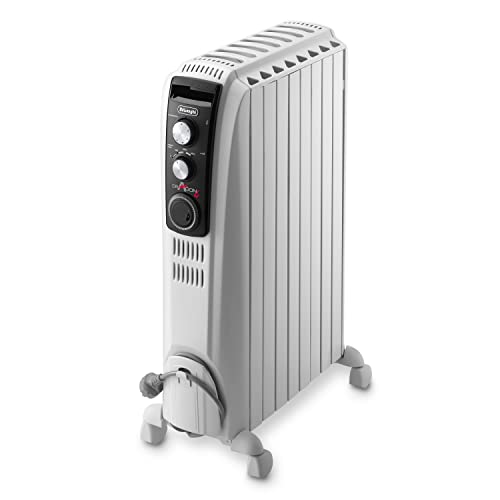
A normal heated room inside the house: an oil-filled radiator on a timer is the sensible choice. Silent for calls, good thermal mass so it cycles off frequently, and a timer means it warms the room before you sit down rather than while you shiver.
A draughty or poorly insulated room, a garden office or a converted garage: use an infrared panel. When a room leaks heat, warming the air is money going straight outside, whereas radiant heat warms you and the surfaces around you directly and keeps working regardless.
A room that is merely chilly rather than cold: skip the room heater entirely. An under-desk panel and a heated throw will cost you about 60p a day and probably be enough.
Avoid making a fan heater your main source. They are cheap to buy and fine for the first fifteen minutes of a cold morning, but they are noisy enough to be picked up on calls, they dry the air, and they rarely have a thermostat good enough to stop them running constantly.
The two heaters we would buy: the De’Longhi Dragon 4 oil-filled radiator for a normal room inside the house, and the Könighaus 800W infrared panel for a draughty one.
Do not create a damp problem while solving a cold one
Heating one room hard while the rest of the house stays cold moves moisture around. Warm damp air migrates to cold surfaces and condenses – on the window, in the corner behind the wardrobe, on the external wall of the unheated room next door. A perfectly warm office can produce mould two rooms away.
The defences are simple: ventilate briefly but properly – ten minutes with the window wide open twice a day exchanges the air without cooling the walls, which is far better than leaving a window on the latch all day. Do not dry laundry in the office. Keep an eye on humidity with a cheap hygrometer and aim for 40–60%. And avoid paraffin or bottled-gas heaters indoors entirely; they release a great deal of water vapour along with combustion products, and they are a poor idea in a small sealed room.
The cheapest realistic setup
Putting it together, the approach that costs least while still being comfortable through a British winter looks like this. Draught-proof the door and window and close the door – free or nearly so, and it reduces everything that follows. Turn down radiators in empty rooms. Put an oil-filled radiator on a timer to bring the office to about 18°C before you start, then let its thermostat hold it there rather than chasing 21°C.
Then close the gap with personal heating rather than more room heat: an under-desk panel for your feet, a jumper, and a heated throw on the worst days. Eighteen degrees plus warm feet is comfortable; twenty-one degrees with cold feet is not, and it costs several times more.
Done properly, that combination typically runs at well under half the cost of keeping the central heating on all day – and it heats the room you are actually sitting in.